
How to Run a Share of Freehold Company: Best Practices


When leaseholders collectively purchase their freehold, usually through a company in which they all hold shares or memberships, the question of how to manage that company well becomes just as important as the purchase itself. Good management after collective enfranchisement protects the building’s value, keeps relationships between residents on solid ground, and ensures the company meets its legal obligations for years to come.
This guide covers what share of freehold management actually involves, which responsibilities fall to the freehold company and its directors, how to choose between self-management and appointing a managing agent, and the practical steps you can take to put your building’s management on a firmer footing today.
If your building has already bought, or is thinking about buying, the freehold, getting the management structure right early can prevent years of stress.
Book a consultation to talk through collective enfranchisement, setting up your freehold company, and whether self-management or a managing agent is the best fit for your block.
Best Practices For Share of Freehold Company Management
In a share of freehold arrangement, the freehold title to the land and building is owned not by a single external landlord but by a company. Each leaseholder in the block holds a share or membership in that company, giving them a direct stake in its decisions, while continuing to hold their own individual lease on their flat. The company, rather than a third-party freeholder, becomes the landlord for the building as a whole.
Following collective enfranchisement, this newly formed or newly owned company steps into every role the former freeholder occupied: managing the building’s common parts, collecting service charges, arranging insurance, and making long-term spending decisions. Understanding what that involves in practice is the starting point for running it well.
Key Management Responsibilities
The freehold company takes on a defined set of core responsibilities after collective enfranchisement. These include maintaining the building’s common parts (hallways, staircases, roof, and structure), arranging buildings insurance and any other required cover, setting and collecting service charges and reserve funds, complying with health and safety and fire safety obligations, and making decisions that stay within both the terms of the leases and the framework of UK landlord and tenant law.
Many of the frustrations that arise in share of freehold buildings do not stem from the collective purchase itself. They stem from the fact that the management framework, roles, and expectations were never clearly agreed or documented at the outset. Getting clarity on responsibilities from the beginning is not a formality; it is what makes everything else more manageable.
Articles, Agreements and Sales of Flats
The rules that govern how the company operates, who can make decisions, how costs are shared, and what happens when a flat changes hands are set out in the company’s Articles of Association, and where applicable in a shareholder or members’ agreement. These documents matter enormously. Without properly drafted Articles, and where appropriate a supplementary agreement, disputes about director powers or voting thresholds can be difficult to resolve, and the transfer of shares or memberships when a leaseholder sells can stall or become contentious.
Clear provisions on how shares or memberships transfer on sale protect both buyers and sellers, and help ensure that the company’s composition reflects the building’s actual ownership at any given time. Vague or outdated Articles are a recurring source of friction in otherwise functional buildings, and addressing them proactively is far simpler than unpicking them after a dispute has started.
Governance and Compliance Basics
Day-to-day governance involves appointing and removing directors, filing annual accounts and confirmation statements at Companies House, holding meetings when required, and keeping adequate records of decisions. These are not optional extras; they are legal requirements that apply to the freehold company just as they do to any other company.
Directors must satisfy two sets of obligations simultaneously. Company law requires them to act in the best interests of the company. Landlord and tenant law requires them to follow the lease terms, consult leaseholders before major works above the statutory threshold, and keep service charge funds properly separated and accounted for. These duties sometimes pull in different directions, and understanding both sets of rules is essential for anyone taking on a director role.
Good governance reduces the likelihood of service charge disputes, challenges to the reasonableness of expenditure, or later questions about whether decisions were properly made.
The Freehold Collective can help leaseholders structure their company and documents correctly at the point of collective enfranchisement, so that ongoing management is clear and robust from day one rather than something to patch up after problems have already emerged.
Day‑to‑Day Management Tasks After Collective Enfranchisement
Once leaseholders own the freehold, the company’s main operational responsibilities include:
- Maintaining the building’s structure, roof, and common parts in line with the obligations set out in the leases.
- Arranging buildings insurance and any required engineering, lift, or public liability cover.
- Preparing annual service charge budgets and collecting contributions and reserve fund payments from leaseholders.
- Planning, tendering, and consulting on major works and long-term maintenance programmes.
- Keeping service charge accounts in a form that leaseholders can inspect if they choose to.
These duties are shaped by both the leases and the applicable legislation. The rules on what counts as reasonable expenditure, the consultation requirements before major works (under section 20 of the Landlord and Tenant Act 1985), and leaseholders’ rights to demand summaries of accounts all sit alongside the lease obligations themselves.
Running a share of freehold company well means having systems in place to handle these tasks consistently, not relying on the goodwill or available time of whichever director happens to be most engaged at any given moment. “How to manage share of freehold” is ultimately a question about infrastructure: whether the right processes, records, and responsibilities are in place to support decisions that will stand up to scrutiny.
Where Things Commonly Go Wrong
The most common pressure points in share of freehold management are predictable: reserve funds that have not been built up over time and leave the building unable to afford significant repairs; a lack of transparency on how service charges are calculated or spent; decisions made informally without proper records; and disagreements between leaseholders about spending priorities or standards.
These patterns appear in buildings of all sizes and are not inevitable. They tend to result from an absence of clear structure rather than from any fundamental disagreement between residents. The sections below set out the two main management routes and the factors that should inform which one a building chooses.
Management Options
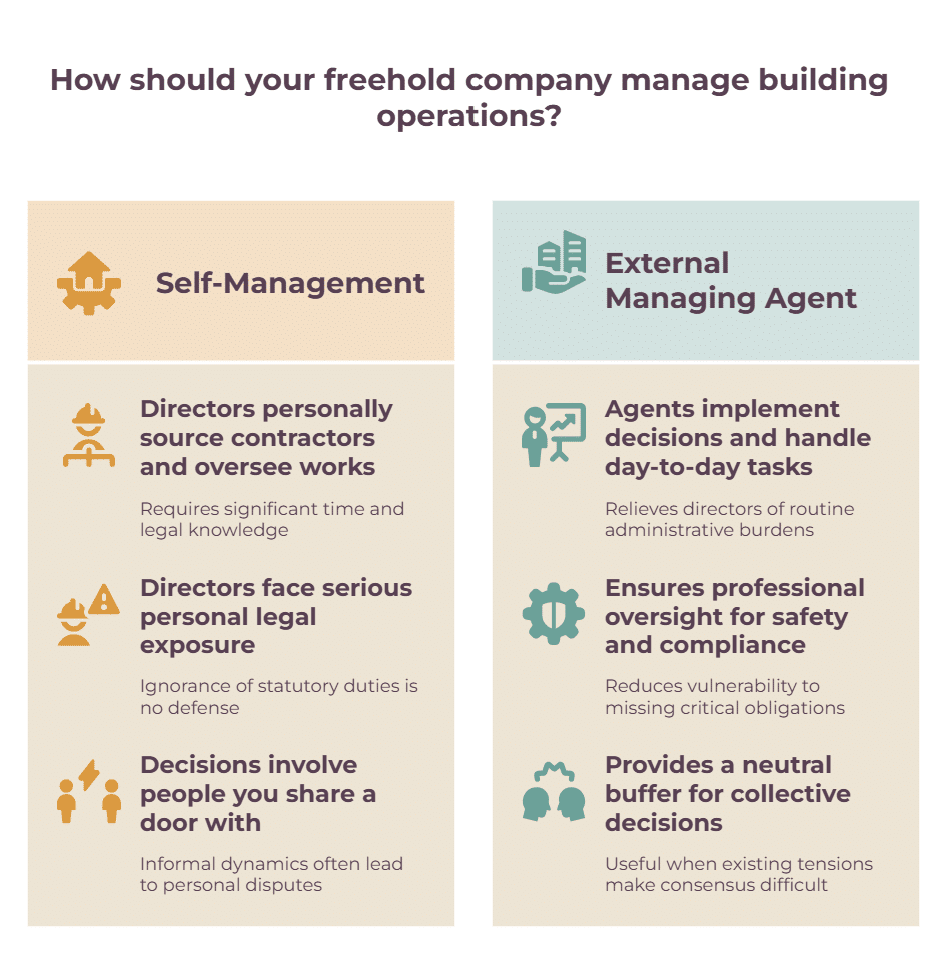
Self‑Managing Through Your Share of Freehold Company
In some small blocks, leaseholders who collectively own the freehold choose to take management into their own hands, with one or more directors volunteering to source contractors, oversee works, prepare budgets, and keep neighbours informed. Where there is genuine trust, spare time, and a reasonable grasp of legal and financial basics, this can function.
The reality, however, is that self‑management carries risks that are routinely underestimated. Volunteer directors are not simply helpful neighbours: they are officers of a limited company with real legal duties, and ignorance of those duties is no defence. The time burden accumulates and tends to fall on one or two people, often leading to burnout or quiet abdication of responsibility.
The legal exposure is serious. Failing to follow the correct statutory consultation process before major works can bar the company from recovering costs through the service charge, leaving directors personally exposed. Safety and fire risk obligations are non‑negotiable, and a block with no professional oversight is genuinely vulnerable to missing something critical.
Then there are the relationships. In a small block, the people making spending decisions are the same people you share a front door with. Disagreements about expenditure or standards can become personal fast, and informal community dynamics are poorly suited to resolving disputes about money or liability.
Self‑management should never be entered into lightly. Even in a two or three flat block, the responsibilities are real, the risks are not theoretical, and the assumption that neighbours will simply sort it out between themselves has a poor track record once something goes wrong.
Hiring an External Managing Agent
Appointing a managing agent is not an all-or-nothing commitment, and there is a wide range of agents offering different levels of service at different price points. The important thing is finding one whose scope of work matches what your building actually needs, at a cost the company can justify. That is a realistic goal for most blocks, including smaller ones.
When leaseholders appoint a professional managing agent, the freehold company and its directors remain legally responsible for the building. The agent does not take over that responsibility; they implement the directors’ decisions, handle day-to-day tasks such as contractor management, service charge administration, and routine correspondence, and often prepare draft budgets and accounts. The directors must still provide oversight, approve significant spending, and ensure the agent is performing as agreed under the management contract.
A managing agent is especially useful when the building is larger or more complex, when many owners are non-resident and have limited day-to-day involvement, when there is already tension among leaseholders that makes collective decision-making difficult, or when significant works are being planned. Even small blocks may choose to appoint an agent if none of the leaseholders has the time, interest, or technical knowledge to self-manage safely and compliantly over the long term.
Next Steps If You Want to Improve How Your Share of Freehold Is Managed
If you want to put your building’s management on a stronger footing, a practical starting point is:
- Gather your company documents (Articles of Association, share or membership records), leases, and the most recent service charge accounts, so you have a clear picture of the legal framework you are working within.
- Map out who currently does what: which directors are active, what informal arrangements are in place, and whether a managing agent is appointed and performing as expected.
- Speak to fellow leaseholders about what is working and what is causing stress, delays, or disputes, so any decisions about changing the management approach reflect the building’s actual experience.
- Decide whether to refine your self-management approach, appoint a managing agent for the first time, or review and if necessary replace an agent who is not meeting the company’s needs.
- Take early professional advice on governance, compliance, and long-term maintenance planning so the building stays legally compliant and well maintained rather than accumulating problems that become expensive to fix.
Even if you are not ready to change your management arrangements immediately, an initial conversation can help you understand your options and avoid storing up problems for the future.
The Freehold Collective works with leaseholders who have already purchased their freehold and with those who are planning to do so. If you are exploring other routes to leaseholder control, our Right to Manage, Purchasing Your Freehold, and Commonhold Services set out the full range of options available to you.