
What Does Retirement Property Mean and Who Can Buy?


Retirement property is a purpose-built housing category with an age threshold written directly into the lease, not a loose marketing label applied to any flat occupied by older people. It carries specific legal weight under the Leasehold and Freehold Reform Act 2024, and those legal details determine who can live there, what you pay in service charges, and how freely you can sell or sublet.
This article answers two questions: what retirement property legally means, and who is actually permitted to buy or occupy one. For leaseholders in retirement developments, understanding both questions is essential before committing to a purchase, because the rights available to you as a leaseholder differ in important ways from those in a standard residential lease.
What Is a Retirement Property?
A retirement property is a purpose-built home within a development that legally restricts occupancy to residents above a defined minimum age, with that age threshold written into every lease within the scheme. Developments typically take the form of grouped flats, bungalows, or cottages, and include communal areas, an on-site scheme manager, and an emergency alarm system as part of the managed service.
Retirement property is designed for independent living, which is the core distinction between a retirement development and a care home. Residents manage their own daily lives; the scheme provides a managed environment and emergency support, not personal care.
The Leasehold and Freehold Reform Act 2024 formalised the definition of a “retirement housing lease”: the lease must include a minimum age requirement of at least 55 years, and that restriction must cover all properties within the scheme. Where a lease meets this definition, it triggers specific protections and obligations for leaseholders. The Leasehold Advisory Service confirms that most leaseholders in retirement houses and bungalows qualify for the right to buy their freehold under the Leasehold Reform Act 1967.
Retirement property schemes generate service charge obligations that are often higher than those in standard residential leasehold, because costs cover on-site staffing, communal maintenance, and building management. Understanding what those charges include, and how much control residents have over them, is a priority before purchase.
Retirement Property vs Sheltered Housing: What is the Difference?
Retirement property and sheltered housing describe different ownership models, not the same product. Retirement housing is typically purchased privately from a developer, while sheltered housing is usually rented from a local council or housing association. Both include an age threshold, typically 55 or 60 years, built into the tenancy or lease.
Age UK describes sheltered housing as “housing-with-support,” which captures its purpose accurately: a rented tenancy with a managed service element, usually including a warden or scheme manager on-site. Local authority sheltered housing operates within a regulated framework; tenants have tenancy rights rather than leasehold ownership.
Retirement housing purchased privately sits within no formal inspection or ratings regime comparable to the frameworks that govern care homes or supported housing providers. Management is handled by a private management company, and the terms governing charges, services, and obligations are set out in the lease. This makes the lease itself the most important document for any buyer to scrutinise before committing.
The practical consequence of that difference: sheltered housing tenants who want to leave and hand back the keys. Retirement property owners who want to sell face the resale constraints their lease imposes, including age restrictions on future buyers and any exit or transfer fees specified in the lease.
The Different Types of Retirement Property
Retirement property is not a single category. Developers and housing providers use different names for schemes that vary substantially in the level of support they include and the age group they serve.
| Type | What it offers | Typical age threshold | Common providers |
| Retirement Living / Sheltered flats | Independent living with on-site manager and communal lounge; no personal care | 55+ or 60+ | McCarthy Stone, Churchill Living, Beechcroft |
| Retirement Living PLUS / Extra Care | Independent living with an on-site bistro, 24-hour care team, and assisted living services available on request | 70+ | McCarthy Stone Retirement Living PLUS |
| Retirement Villages | Large-scale developments combining bungalows, flats, communal facilities, and sometimes an integrated care home on site | 55+ or 60+ | Audley Villages, Inspired Villages |
Property type directly affects the terms of the lease, the structure of the management company, and the level of service charges. A Retirement Living PLUS scheme that employs a 24-hour care team will carry materially higher service charges than a standard sheltered flat with a part-time manager. The lease governs how those charges are set, how they can increase, and what recourse leaseholders have if they dispute them.
Who Can Buy a Retirement Property?
There is no legal restriction on who can own a retirement property; the age restrictions in the lease apply to who can live there, not who can hold the title. This distinction matters because it opens purchase to adult children buying on behalf of a parent, and to investors and landlords buying to let, provided the occupant meets the development’s age criteria.
Typical Age Thresholds
Most retirement developments require at least one occupant to be aged 55 or 60, depending on the scheme. Where a couple purchases together, many leases require both parties to meet the minimum age. Check the specific lease rather than relying on a developer’s marketing literature, as the lease is the binding document.
Can an Adult Child Buy Retirement Property for a Parent?
Yes. An adult child can purchase a retirement property as the registered owner, provided the occupant (the parent) meets the age and eligibility criteria set out in the lease. Churchill Living and Beechcroft both confirm this arrangement is permitted within their schemes. The purchase proceeds in the normal way; the owner’s age is not subject to restriction.
Can Investors and Landlords Buy?
Investors and landlords can purchase retirement properties, but subletting rules vary significantly between schemes and must be checked in the lease before any purchase intended for rental. Many retirement leases restrict subletting to occupants who meet the development’s age criteria, which substantially narrows the pool of potential tenants. Some leases prohibit subletting entirely.
There is no upper age limit on buyers or occupants in any UK retirement development.
Leasehold and Freehold: What Retirement Buyers Need to Know
The vast majority of retirement properties in the UK are sold leasehold. Age UK notes that almost all retirement properties are leasehold arrangements, meaning the freeholder retains ownership of the building and land, while leaseholders own their home for the duration of a fixed term set out in the lease. Understanding what that means for your rights, costs, and long-term security is not optional for a retirement property buyer.
A retirement lease typically includes: a minimum age restriction on occupancy, subletting clauses (often prohibiting or restricting lettings to non-qualifying tenants), service charge obligations, provisions for an on-site manager, and exit or transfer fees payable on resale. The specific terms vary between developers and individual schemes.
Can Retirement Leaseholders Buy Their Freehold?
Most leaseholders of qualifying apartment buildings, retirement houses and bungalows qualify for the right to purchase their freehold under the Leasehold Reform Act 1967, as confirmed by the Leasehold Advisory Service.
This right eliminates the freeholder’s ongoing control over service charges, building management decisions, and lease terms, which carries significant long-term financial implications for retirement property owners.
Collective Enfranchisement for Retirement Flat Owners
Flat leaseholders in retirement developments can also pursue collective enfranchisement, which is the right for a qualifying group of leaseholders to purchase the freehold of their building together. For retirement flat owners, collective enfranchisement is often the most effective route to removing an unresponsive or costly freeholder from the management structure entirely.
Leaseholders who do not qualify for freehold purchase, or who want interim control of their building’s management without a full enfranchisement, may qualify for Right to Manage. This allows a qualifying residents’ group to take over management responsibilities from the freeholder without purchasing the freehold. Lease extension is also available to retirement leaseholders whose term is running low, which directly affects both property value and mortgageability.
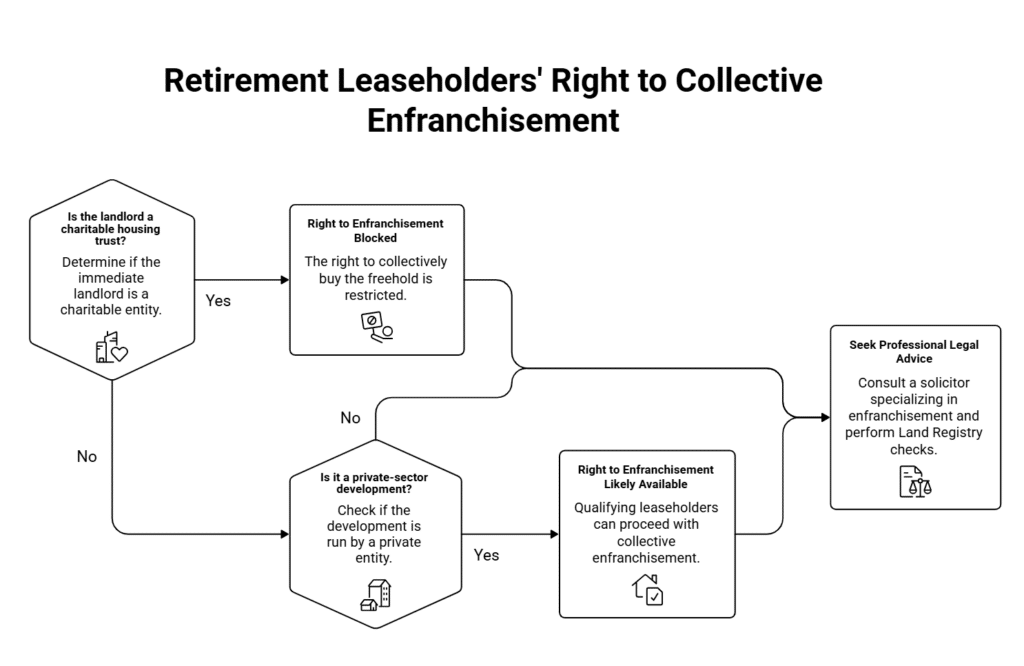
Infographic explaining the process of implementing the Right to Collective Enfranchisement for Retirement Leaseholders
Buying Options: How You Can Purchase a Retirement Property
Retirement property buyers have 3 main routes to purchase, each with different eligibility criteria and financial implications.
- Outright purchase: Cash buyers and those using a mortgage can purchase retirement properties outright. Some lenders impose age limits on mortgage terms, so it is worth checking lending criteria before applying. Many retirement property buyers are cash purchasers as a result of these restrictions.
- Older People’s Shared Ownership (OPSO): Available to buyers aged 55 and over with a household income under £80,000 (£90,000 in London), OPSO allows buyers to purchase a 25% to 75% share of a property. Crucially, once the buyer reaches 75% ownership, no rent is payable on the remaining share. This route is available through housing associations and makes retirement property accessible to buyers who cannot fund a full outright purchase.
- Part exchange: Several retirement property developers, including McCarthy Stone and Churchill Living, accept existing homes as part payment toward a new retirement property. This removes the need to sell independently before completing a purchase and can simplify the moving process considerably.
Things to Watch Out For Before Buying a Retirement Property
Retirement property purchases carry risks that do not apply to standard residential leasehold. Six areas warrant close scrutiny before exchange of contracts.
Exit and Transfer Fees
Some retirement leases require the payment of a percentage of the sale price, or sometimes a percentage of any increase in value, when the property is sold or changes occupancy. These fees are sometimes described as “event fees” or “deferred management charges.” The Law Commission previously raised concerns about transparency around these fees. Always check the lease for any such provisions before committing.
Resale Restrictions
Age restrictions in the lease mean the property can only be sold to buyers who meet the minimum age criteria. This narrows the resale pool substantially compared with standard residential property. Retirement property specialists note that resale in these developments tends to be slower, and values can be more volatile because of the restricted buyer pool.
Subletting Clauses
Many retirement leases prohibit or severely restrict subletting to tenants who do not meet the development’s age criteria. Buyers intending to let the property, or who may need to let it temporarily in future, must check the subletting provisions in the specific lease rather than assuming standard residential subletting rights apply.
Service Charges
Service charges in retirement developments are typically higher than in standard residential leasehold because they cover on-site management, communal staffing, building maintenance, and emergency systems. Charges can increase substantially year on year. Ask for 3 years of historical service charge accounts before completing, and check the lease for any cap or consultation requirements before major works expenditure.
Lease Length
Any retirement property with fewer than 90 years remaining on the lease warrants a careful review. Leaseholders have a statutory right to extend their lease, but the cost increases as the remaining term shortens. Securing a lease extension before the term drops below 80 years is the most cost-effective approach.
Summary: What Retirement Property Means for Leaseholders
Retirement property is purpose-built housing with an age restriction built directly into the lease, typically 55 or older. Ownership is legally unrestricted, meaning anyone can buy, but residency is limited to those who meet the development’s criteria. Adult children can buy for a qualifying parent; investors can buy to let, subject to the lease’s subletting terms.
The majority of retirement properties are sold leasehold. That means buyers enter a long-term contractual relationship with a freeholder, with all the service charge obligations, resale restrictions, and management limitations that a leasehold arrangement carries. Knowing your rights as a leaseholder in a retirement development, including the right to buy your freehold, pursue collective enfranchisement, apply for Right to Manage, or extend your lease, is the most important preparation any retirement property buyer can do.
Book a free consultation with The Freehold Collective to understand your options as a leaseholder in a retirement development. Our team works exclusively on leasehold matters and can advise you on freehold purchase, collective enfranchisement, Right to Manage, and lease extension for retirement property.
Get in touch today and start the conversation
What Does Retirement Property Mean FAQs
Are retirement properties a good investment?
Retirement properties carry real financial risk that distinguishes them from standard residential property. Around half of new retirement homes resold during a ten-year period sold at a loss, and buyers typically pay 17% more for new build retirement properties than comparable standard homes, meaning the premium paid on entry is rarely recovered on the open market. The restricted buyer pool created by age restrictions and, in many cases, high service charges mean resale values are more volatile and slower to realise than most buyers anticipate.
Why are retirement flats hard to sell?
Most retirement properties are leasehold, which already limits buyer interest relative to freehold homes, and a retirement flat carries the additional constraint that any buyer must meet the age threshold written into the lease. High service charges are a frequent deterrent when buyers carry out due diligence, and any exit or transfer fees in the lease reduce the net proceeds for the seller. Together, these factors create a narrower, slower-moving resale market than standard residential property.
Does ground rent apply to retirement properties?
New retirement homes built under regulated leases after June 2022 should carry no annual ground rent, following the Leasehold Reform (Ground Rent) Act. Older leasehold retirement properties may still include historic ground rent clauses that remain legally binding on whoever owns the property now, so any resale retirement property warrants careful lease review before purchase. Your conveyancing solicitor should confirm the ground rent position and whether any review mechanism applies.